Ever hit a wall of grief and pain? The road of healing includes guiding your thoughts to positive possibilities — even while giving yourself space to do some grieving. I’ll share three questions that help you step forward in life.
When we really face it, we have two things: this present moment and the next moment. But many of us get stuck in either guilt/regrets of the past or worries of the future.
What brings us to this present moment? A question.
Some questions empower us. And others tear us down like: “Why does this always happen to me?” or “When will I stop being [clumsy, stupid . . . any other self-degrading remark]?”
Instead, an empowering question will turn the direction of your thoughts to what you can use to improve this moment and the next moment.
Here are 3 Power Questions my clients use:
* What did I learn?
* What did Higher Power want me to get from this?
* How can I move forward and carry the lesson for the better?
For those people who have a spiritual path, the second question gets them out of their own ego.
I have learned, as I was grieving the death of a close friend, that I could learn a number of lessons.
For example, after a close friend committed suicide, I supported another friend “Sam” by asking, “Do you need a suicide watch?” [A suicide watch is when friends take shifts so someone will be with a depressed person 24/7.] That took courage because I risked Sam’s anger.
However, Sam said, “Thank you for being concerned. I am okay.”
I invite you to use these three questions. Discover what next positive thing can be part of your life journey.
Here’s another important detail. I have learned to be grateful for what I have–and what I enjoyed in the past.
As I step into a new day and I find that some things change, I’ll say, “I’m in a new chapter of my life. I’m grateful for what happened in the previous chapter. And I’m fully present for this new chapter.”
As an Executive Coach, I help my client develop skills, strength and stamina. During the process, the client will take new action and take new appropriate risks. And there are times when life throws in some hardship.
So if you’re experiencing some hardship (perhaps, losing a friend or a job or a possession like a totaled car), see if you can grieve AND employ the 3 Power Questions:
* What did I learn?
* What did Higher Power want me to get from this?
* How can I move forward and carry the lesson for the better?
Warmly,
Tom
Tom Marcoux,
CEO
Speaker-author of 27 books (with free chapters on Amazon.com )
Executive Coach
Spoken Word Strategist
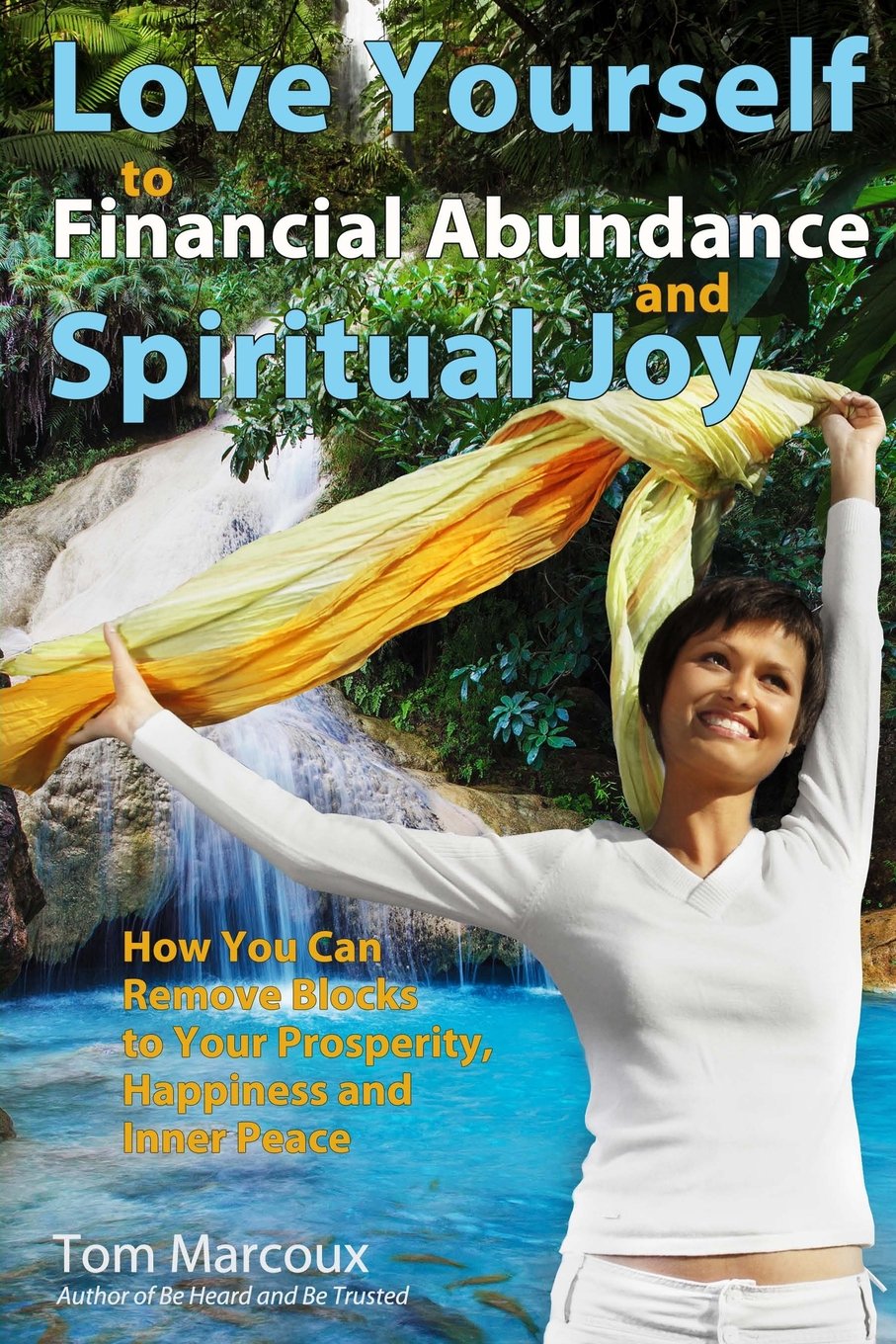
Author of Love Yourself to Financial Abundance and Spiritual Joy: How You Can Remove Blocks to Your Prosperity, Happiness and Inner Peace (Free Chapter when you CLICK HERE )
Some years ago, I had business cards from nine people after first meeting them at a Chamber of Commerce event.
I knew I should follow up with them. But then I hesitated. I had some dis-empowering feelings like: “Oh, they’ll think I’m bothering them” and “They’ll think I’m trying to sell them something.”
Did I follow up? No. In fact, their business cards got lost in a file somewhere.
Can you relate to that experience?
Years later, I’ve learned how to be more skillful about new contacts and follow-up. As an Executive Coach, I’m often asked by my clients to train them in powerful networking methods. This led to my including my methods in my book Now You See Me – Make a Great First Impression – Use Secrets of Power Networking: for More Clients, More Referrals and More Friends (see a Free Chapter when you CLICK HERE.)
Want to truly expand your success? Learn to transform how you follow up with people. Many people simply fail to follow up because of two incomplete perceptions that follow up is “drudgery” and “bothering someone again.” Stop! You can make follow up into something that the other person welcomes!—and that you’re comfortable doing. You’ll actually feel good as you do the follow up activities.
First you need to transform “follow up” into what I call “Follow-Good.” The other person feels good while you contact them, and you feel good about the process. You stop dreading your follow-up actions. We’ll use the G.O.O.D. process:
G – get ready ahead of time
O – organize a system
O – open dialogue
D – do follow up in 2 minute segments
1. Get ready ahead of time
The essence of “Follow-Good” is to transform yourself from an intruder into a “host” and an “invited guest.”
To do this, you need to get ready ahead of time.
For example, when I attend an in-person networking event, I bring 3×5 cards. Why? So I can take notes at an appropriate time. For example, if you’re talking with someone from an Asian culture do NOT write on their business card. I hold my 3×5 card next to their card and I write notes on the 3×5 card and then place the person’s card into my folded 3×5 card. Then the cards together go into my pre-selected pocket.
The above process is to for you to identify what the person is interested in. This will give you clues as what you can give to the person that will brighten his or her life. Let’s say that Sarah’s daughter is taking karate classes, you can send a copy of an article that shows how girls can excel in martial art classes.
Bob Burg, author of Endless Referrals emphasizes the value of sending people a hand-written follow-up card. Here’s how you can get ready ahead of time.
In advance, set up your thank you cards. Have them ready to go in a #10 envelope that has your handwritten return address, and hand-applied postage stamp.
Then, the same night of a networking event, fill out the card (which has your photo and contact information) and place the completed cards in a mailbox. [Sure, you could send an email message, but everybody does that. And no one stands out.]
2. Organize a system
To do follow up effectively and with little pain, it’s good to use a system. As you develop this system, think of ways for you to streamline the system into easy steps. You need to feel good as YOU do the follow-up work. Hence my phrase: “Follow-Good.” You’re actually doing a good work. You’re providing a benefit for the other person.
Here’s an example of a system:
1) Meet the person at a networking event.
2) Send an email the same night of the first encounter OR
send a follow-up, handwritten card (in a #10 envelope).
3) Place in your calendar system a prompt to remind you to find a suitable article that might be useful to the person.
4) Print out that article and send it.
Each person will find how to customize his or her own system. Bob Burg suggests that one send a notepad with one’s photo and contact information on each page. Bob feels that such a notepad keeps you in front of the prospective client’s eyes.
3. Open dialogue
Consider your follow up activities as continuing a positive dialogue with the new person. And certainly, connect with the person simply to say, “How are things going?” This works well in social media. Often, I’ll see that someone is online and available for a chat at Facebook. So I simply type, “Andrea, how are things going?” And then I “listen” as they often vent about something. With me, they have an empathetic ear. The person sees that I’m demonstrating care and concern.
4. Do follow up in 2 minute segments
What gets done? Something that is easy and fast to do. You can follow up with a person in a short amount of time. For example, in 1988 a New York Times article revealed how movie executive Jeffrey Katzenberg made up to 600 phone calls a week. He was called “the master of the 2 minute phone call.” Katzenberg had two secretaries who split the Katzenberg day between them. They placed the calls and had people hold on so that Katzenberg could go from one conversation to the next.
Katzenberg’s example is extreme. But we can take some inspiration that it’s valuable to stay in contact with people. As an Executive Coach, I’m often encouraging my client to use a better system to stay in contact with vital people for the client’s business success.
Here’s another example. Consider having an open file carton next to your desk. When you think of a follow-up idea, jot it down and toss it into the open file for a particular person. Or jot the idea down in a reminder that you place into the online calendar system.
The really powerful Follow-Good practice is to jot a handwritten note down in 2 minutes. Later, in the day, take two minutes and get that note into the mail.
Praise people. Celebrate their special day. For example, a while ago, I called a friend and said, “Happy today. We can celebrate that one year ago today, you finished writing your first book!”
People appreciate that you notice their special days.
Learn to Follow-up well and network your way to real success; Book: “Now You See Me” available at Amazon.com
Use these “Follow-Good” methods:
G – get ready ahead of time
O – organize a system
O – open dialogue
D – do follow up in 2 minute segments
Consider asking people in your networking circle these important questions:
How can I recognize a good client for you?
How can I be supportive of what you’re doing?
When they tell you, you can get some time to consider how you might help. (I call such time “thinkspace.”) Reply with something like: “I hear you. It would be great for me to promote your book from my Facebook wall. I need to double-check a couple of things. How about I get back to you on Thursday afternoon?”
One of my clients faced such a situation. When she got back to the person, she said, “I’ve found a way to be helpful. I can send out a tweet about your new book. I’m comfortable with that.”
Remember, we can develop a Circle of Success.
We can actually feel good about how we help other people. We become the “host” of good things that we do—including connecting people in our network.
When you call, you’ll be treated like an invited guest.
This is all based on what I call “The 3 Magic Words of Networking: ‘Help Them First.’”
Good journey.
Warmly,
Tom
Tom Marcoux,
CEO
Speaker-author of 27 books (with free chapters on Amazon.com )
Executive Coach
Spoken Word Strategist
Author of Love Yourself to Financial Abundance and Spiritual Joy: How You Can Remove Blocks to Your Prosperity, Happiness and Inner Peace (Free Chapter when you CLICK HERE )
Marc Allen and Tom Marcoux – Tom holds Marc’s book “Tantra for the West”
Recently, I learned from author Marc Allen as he gave a speech on his book Tantra for the West: A Direct Path to Living the Life of Your Dreams.
Marc emphasized that “although tantra is usually thought of as sex with some kind of mysticism thrown in, the original meaning of tantra comes from the ancient Sanskrit root word meaning ‘to weave.’ Tantra applies to every moment of your life, excluding nothing. Within your way of life, within your everyday thoughts and feelings, are the keys to love, freedom, and fulfillment.”
Marc devoted a number of years to living and studying at a center of tantric Buddhism run by a respected Tibetan lama. Over the subsequent years, Marc found a way to express the profound ideas and practices to Westerners.
During his speech, Marc told a powerful story of how he turned around his life and finances by creating a powerful affirmation. When he was struggling and in serious debt, he berated himself. Then, as a whole new direction, he focused on what he truly wanted and used this affirmation:
I am sensible and in control of my finances. I am creating total financial success, in an easy and relaxed manner, a healthy and positive way, in its own perfect time, for the highest good of all.
(from page 122 of his book. Look inside Marc’s book when you CLICK HERE)
Marc went from being a struggling publisher to the publisher of The Power of Now by Eckhart Tolle (estimated 3 million copies sold in North America).
In his book, Marc reveals: “The path of tantra is the path of leaping into the fire of our feelings. It is path of tremendous power and true freedom. It means acknowledging our feelings at every moment.”
I’m so glad that I have a copy of Marc’s book. I love learning from a great teacher.
* * *
I truly agree with Marc’s approach. In his book he emphasizes that when we work with our feelings in the moment and in healthy ways we free ourselves from anger and the health consequences of retained anger.
I also appreciate Marc’s affirmation: “I am sensible and in control of my finances…”
Marc’s affirmation is more than an expression of wishful thinking; it is a road map.
In reflecting on Marc’s affirmation, I came up with a quick overview of how each part of the affirmation can be used as a guide:
I am sensible and in control of my finances. [I set up a household budget and budget for each project.]
I am creating total financial success [I identify how I can build a business that reaches and serves more and more people.]
in an easy and relaxed manner, [I make sure to take breaks so I am refreshed and pleasant to the people I talk with.]
a healthy and positive way, [I exercise daily. I make sure to see something funny on video so I enjoy laughter daily.]
in its own perfect time, [I acknowledge that my ego may want it to happen immediately, but my soul can acknowledge that things are happening with great timing.]
for the highest good of all. [I conduct my business as a service for all of us to benefit.]
May you explore ways to be kind to yourself and open yourself to express your creativity.
Warmly,
Tom
Tom Marcoux,
CEO
Speaker-author of 27 books (with free chapters on Amazon.com )
Executive Coach
Spoken Word Strategist
Author of Love Yourself to Financial Abundance and Spiritual Joy: How You Can Remove Blocks to Your Prosperity, Happiness and Inner Peace (Free Chapter when you CLICK HERE )
I recently saw four of my friends have money troubles and I had a surprising thought: “If they loved themselves more, they would have been in better shape.” Then, my thoughts crystallized when I saw my cat walk into the room where I was typing on a desktop computer.
I realized that my cat naturally does three things–and these can apply toward increasing one’s financial abundance.
1. Be yourself
My cat, Magic, simply expresses himself as a cat. He doesn’t try to bark or chase cars.
Now, how does this apply to increasing our financial abundance? I’ll give you an example. Some years ago, I sat in a room of 23 attorneys who did not want to be attorneys. They had the law degree but then discovered that they did not find the day-to-day work appealing. These were not happy, successful attorneys!
My point is that we are less likely to excel at what we do not like. And often what we do not like relates to where our skills and native ability is lacking.
Instead, focus on your areas of great interest.
Secondly, don’t compete–be yourself and create. To create more financial abundance it’s often better to create your own category instead of trying to jump into a category that already has intense, existing competition.
For example, there is no one just like Whoopi Goldberg. She’s an African American woman named after a cushion and a Jewish person. How’s that?
We’re here for a reason. I believe a bit of the reason is to throw little torches out to lead people through the dark. – Whoopi Goldberg
2. Be where you can get what you want
I frequently encounter my cat in the kitchen. Why? That’s where the food is. It’s simple. He wants a treat and he’s next to the refrigerator.
Now, it’s your turn:
What do you want? And where is it?
For example, let’s say you want to raise money for making a feature film. Where are the film investors? Some years ago, I attended a meeting in Palo Alto, California. In the meeting were film investors. If a filmmaker wanted to have a chance to get funded by these particular investors, they needed to be in that room at that time.
For some forms of business, you need to go where the fans are. At one point, there was a TV show entitled Heroes of Cosplay, which featured people who travel to many comic book conventions. That’s where the fans are.
3. Ask for what you want
I’ve just scratched under my cat’s chin for the seventh time in a row. I’m not a cat owner; I am cat staff.
Magic speaks up and asks for what he wants: Attention and specifically to be scratched under his chin. When I scratch him behind the ears, he actually lifts his chin for me to scratch exactly where he wants.
How does this apply to increasing your financial abundance? In the following ways:
You need to . . .
ask for the sale
ask for someone to take a moment and listen to you
ask for help
ask for support
ask for new ideas
ask for referrals for your business
A Special Note about Love Yourself to Financial Abundance:
I’m emphasizing “love yourself” because, for many of us, to increase our income we’re going to need to do new things and sometimes put in extreme efforts. We need to take great care of ourselves because we need extra energy to do extraordinary things.
When you love a child, you make sure the little brushes his or her teeth. The child will likely give you resistance but you’ll brave it because the child’s well-being is of primary importance. When you love yourself, you’ll do the tough things to make sure that you become the person you want to be, who attracts success and financial abundance. [This is so important to me that I wrote a whole book on the topic: Love Yourself to Financial Abundance and Spiritual Joy: How You Can Remove Blocks to Your Prosperity, Happiness and Inner Peace – Free Chapter when you CLICK HERE ]
Book: “Love Yourself to Financial Abundance and Spiritual Joy” available at Amazon.com
For example, I started off as a shy 9-year-old boy terrified while playing the piano for seniors in a retirement home. So I gained the coaching and training–and did hours of rehearsal–to become a professional speaker and leader of companies. Why? Because I wanted to get big things done. I loved myself enough to invest in my training. I was also realistic in understanding that a lot of rehearsal would help develop new skills and new patterns of speaking and performing.
As an Executive Coach, I assure my clients about the power of having someone support you as you stretch and grow.This is a fact I know. I had 3 excellent high school instructors:
* One taught psychology — I earned a degree in psychology.
* One taught English literature– I wrote 27 books and screenplays — and directed feature films.
* One taught theology — I wrote a college online course in Comparative Religion that I have been teaching for over 13 years.
Some time ago, I posted a question to my 5,795 Facebook contacts–and I submit it to you now:
What positive thing would you do if you loved yourself enough or loved yourself more?
Write down your answer.
Make a plan.
And take action to expand your financial abundance.
In essence, love yourself to financial abundance.
Warmly,
Tom
Tom Marcoux,
CEO
Speaker-author of 27 books (with free chapters on Amazon.com )
Executive Coach
Spoken Word Strategist
Author of Love Yourself to Financial Abundance and Spiritual Joy: How You Can Remove Blocks to Your Prosperity, Happiness and Inner Peace (Free Chapter when you CLICK HERE )
Celebrate how you can make this year something you feel Great about!
The tension at the table in the restaurant felt like a smothering blanket. My former business associate looked at me with barely contained anger. Things had not gone well. We had learned the hard way that we were not a match for working on a project together. The resulting impasse had cost months of paperwork.
I reached over for a napkin and my suit sleeve caught on my water glass. Then it was like time stopped for a moment. My water glass balanced on its edge, then SPLASH—water spilled all over the table.
Amazing! That was just the thing to dispel the tension. And the matter between us was ultimately resolved. It began with a suit sleeve and a glass of water.
When you’re working on projects that are long term and mean so much to you, you’re likely to meet with resistance. The Big Goals often include big obstacles and we need strategies to help us carry on.
A certain few people will make this year a great year for themselves. Many others will quit. But not you—when you apply the following strategies embodied in the N.E.W. process:
N – nurture Levels of Goals
E – energize through new ideas/skills
W – work the Worst First cure to procrastination
1. Nurture Levels of Goals
Whether you keep going or quit depends on your skills to use your emotion to energize your continued progress.
By this I mean, your emotion, properly channeled, can help you endure and ultimately fulfill your Big Goal.
A lot of people quit when their positive feeling (like “Oh! I look forward to being 40 pounds lighter”) fizzles out.
To really be sure to keep going, it helps to have multiple Levels of Goals.
I’m talking about not just relying on “positive motivation.” Instead, use whatever works!
The solution is to use 3 Emotional Focus-Points:
3 Emotional Focus-Points:
Golden Pull Goals
Dark Boot Goals
Green Tranquility Goals
Let’s tackle the Golden Pull Goal (positive goal) of getting more sales. Sure, that’s a positive thing. You might even make a plan to give yourself a personal reward when you accomplish more sales.
However, many of us realize that what really pushes us forward is a Dark Boot Goal. It’s like a boot that kicks us in the rear end. In this situation, a Dark Boot Goal would be “avoid having to tell my wife that our vacation is cancelled because I failed to sell enough widgets.” You work hard to make sure what you fear does NOT happen.
Along this line, here’s another powerful Dark Boot Goal: “avoid tax penalties by turning in my tax return on time!”
Finally, after achieving many goals, I realized that I need goals that would sustain my well-being. I call these goals Green Tranquility Goals. I recall hearing about a building that was built to be “green” and “self-sustaining.”
We, human beings, need to be self-sustaining, too. For example, I take a walk with my sweetheart every day, and that is one of my Green Tranquility Goals. It helps me feel calm and peaceful.
So when you set a goal, be sure to set up a related Golden Pull Goal, Dark Boot Goal and Green Tranquility Goal.
2. Energize through new ideas/skills
You cannot solve a problem on the same level in which it was created. – Albert Einstein
When I was in my 20’s I needed to raise funds to produce a feature film. I had no idea how to do it. And for months I really suffered because I had a dream but also had big fears and no new skills. So what did I do? I gained a number of mentors and also began reading a lot. Now, I tend to read 81 books a year.
My focus is on getting new ideas and new skills each year because I do not know what new opportunities may arise.
More than that, as an Executive Coach, I’m constantly studying new trends and methods so my clients can Move Forward Fast.
With my clients and graduate students, I emphasize this idea: “You need preparation so that you’re strong to face the unknowns.”
To really make sure you have the time management skills and ways to overcome procrastination, please consider my book: Nothing Can Stop You This Year!: How to Unleash Your Hidden Power to Persuade Well, Get More Done, Gain Sudden Profits, Command Intuition and Feel Great! (See a Free Chapter when you CLICK HERE).
3. Work the “Worst First cure” to procrastination
For many of us, procrastination is a habit. It’s almost like a default setting. We feel that something may be unpleasant to do so we go on “automatic” and put it off.
Here’s a better habit—an empowering habit: “Worst First.” By this I mean do the Worst Task first. Here’s an important observation: The task you dread the most is the most important one for your career.
If you’re dreading updating your resume, it’s probably the most important thing for you to do. [Learn more in Power Time Management: More Time, Less Stress, and Zero Procrastination (Your Breakthrough for More Success, Happiness and Time Off) [See a Free Chapter when you CLICK HERE]
As an Executive Coach, I see that some of my clients dread marketing and, of course, many of them would do the best thing for their business by getting help to do better marketing. This blog is YourBodySoulandProsperity.com — and I know that we can eliminate blocks to the flow of more prosperity in our life. Now, see my 1.7 minute video that pulls back the curtain so you see how directing a feature film that went to the Cannes Film market and training Stanford University MBA students all add up for how I help people rise to higher levels of Real Success:
Personally, I dread doing paperwork. How do I handle it? I work on it first thing in the morning. 30 minutes a day adds up when you do the Worst First task consistently.
Observe yourself. When do you have energy? When you wake up? Or later in the day? Or are you a night owl?
One of my clients writes from 5 pm – 6 pm because he has a “second wind” at that time.
Use your best energy to apply to your Worst First task.
One college professor cleared his apartment of clutter by using the first 15 minutes of each day to clear clutter and straighten up. Soon his living quarters were in great shape.
Now it’s your turn.
What do you want to improve for this year?
Identify your Worst First task and get going.
Make this year an outstanding year for yourself. Apply the N.E.W. process:
N – nurture Levels of Goals
E – energize through new ideas/skills
W – work the “Worst First cure” to procrastination
You deserve to live the life of your dreams.
It begins today.
Warmly,
Tom
Tom Marcoux,
CEO
Speaker-author of 27 books (with free chapters on Amazon.com )
Executive Coach
Spoken Word Strategist
Author of Love Yourself to Financial Abundance and Spiritual Joy: How You Can Remove Blocks to Your Prosperity, Happiness and Inner Peace (Free Chapter when you CLICK HERE )
You can LOVE your life–and learn from successful people.
Are you barely hanging on? Do you wonder where your zest for living went? We’ll use the F.R.E.E. process:
F – fuel
R – release
E – excitement
E – engagement
1. Fuel
When you want to feel free and enjoy your life, you’ll make sure that you have enough “fuel.” Without appropriate nutrition and sleep, you’re running on near empty. It just doesn’t work. How do you get enough sleep? I’ll share what I do: I keep a log. When I see that I have missed some sleep, I take steps to get more sleep on the next day.
Be sure you have enough fuel so that you feel good and strong. Exercise forms part of your “fueling system.” Regular exercise actually adds to your personal energy.
I find that reading is fuel to me. I stay excited about ideas and ways to help my clients, graduate students, and readers of my own books.
2. Release
Life can be tough. Things happen and we feel burdened by painful feelings. You simply need time to release the painful feelings and experience the good side of life.
Another way to say this is: “Plan your release.” What is a release? It’s something that you do to expel painful energy.
Exercise helps many of us release the stress we feel.
I purposely get laughter-time daily. I watch stand-up comedy moments on YouTube or view comedy-related shows on my digital recorder or DVDs/Blu-ray discs. Everyday.
Many of us find that quiet time or moments for spiritual connection (prayer; meditation) to be helpful.
3. Excitement
Are you just going through the motions? Are you dragging through life? It’s important to notice your daily mood and approach to life. And then do something to put more life into your life.
Unfortunately, a number of people allow themselves to fall into and remain in a rut. I’ve asked a number of people, “What are you looking forward to?” Two people routinely had nothing to say. One of them even resented that I asked the question. That guy is no longer part of my life (his choice)–and what a relief! What a miserable person!
But this is NOT for you.
Doing the same thing day in and day out can create the feeling of “blah.”
On the other hand, you have the choice to make something enjoyable and exciting take place.
Here’s a principle that I use: Make it a game that you can win.
Many people allow themselves to fall into a frustrating pattern of trying to control the actions of others. They complain about their disappointments; and they’re engaged in a game that theycannot win.
But we can control our own efforts. For example, earlier this year, on one particular day, I decided: “Today is the day I finish my new book.” And in that same day, I had my book up on Amazon.com as a Kindle book.
It was exciting for me to watch with anticipation for the time the book went “live” on Amazon.com.
Along this line, here are other principles for bringing some excitement to your life:
* Push on through so you can succeed somewhere. (Even a small success can give you the energy boost to keep going.)
* Aim for more than one thing.
* Have something new coming up.
* Enjoy today AND have something you look forward to.
Happiness is pretty simple: someone to love, something to do, something to look forward to.” – Rita Mae Brown
4. Engagement
I always remember a book I read as I completed my degree in psychology. The author Irvin Yalom proposed that the solution to the problems of life is one thing: Engagement. What does that mean? Get connected! Get involved!
Over several years, I have faced some tough times. (The suicide of a close friend is one of them.)
One powerful way I stay engaged is I make sure to make a contribution to the well being of other people. For example, when I talk about my work coaching graduate students and clients, I say, “I’m grateful for meaningful work.”
Perhaps, at the moment, you’re not pressing to find a job that’s more inline with your deepest heart. Then, consider setting up a situation so that you can say something like: “I’m grateful for my meaningful volunteer work on Saturdays.”
Or “I’m grateful for my meaningful hobby.”
So I’ve learned that a powerful part of engagement is having something to feel grateful about and to have some way to contribute to the well being of another person.
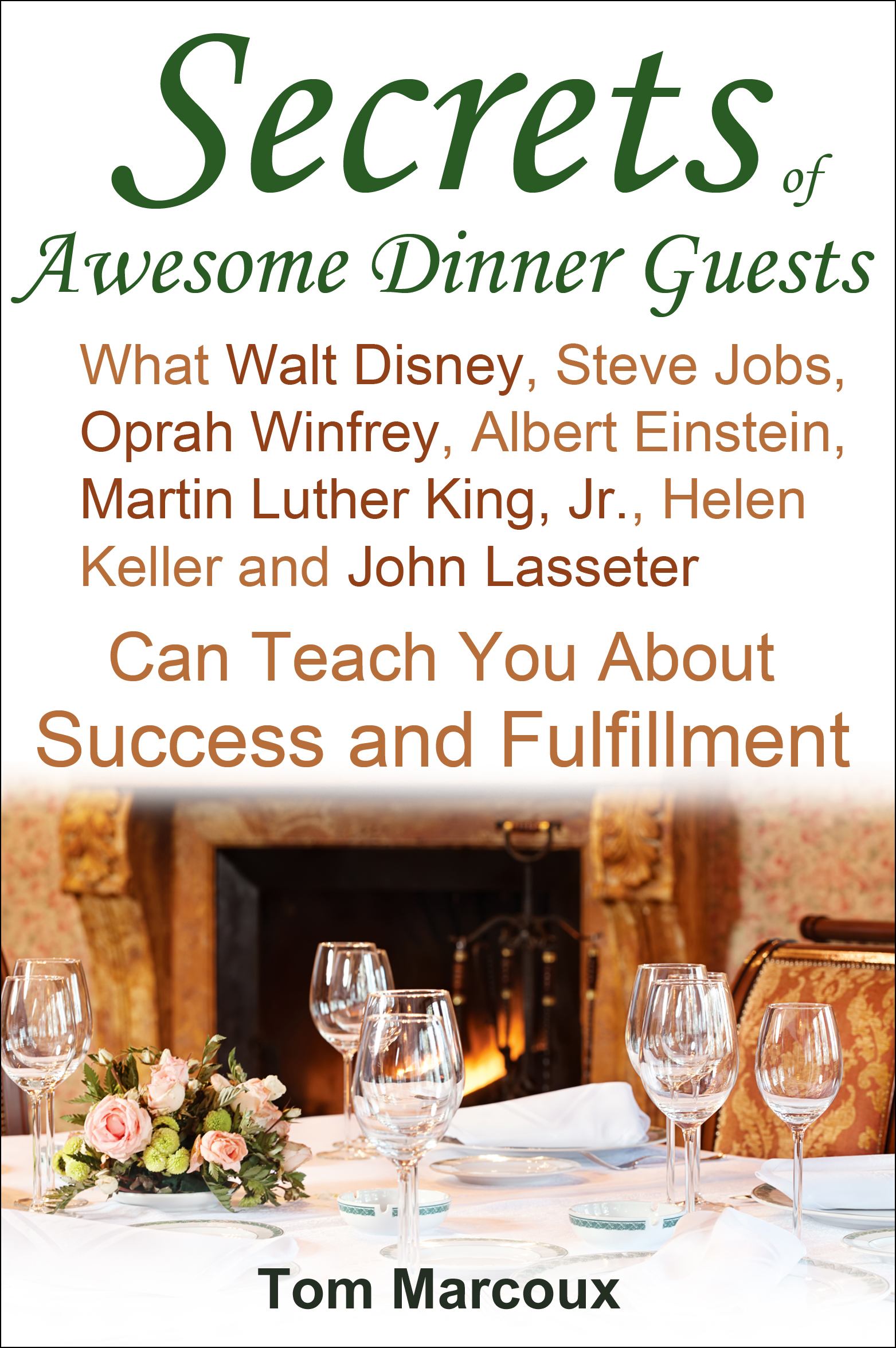
In writing 27 books, I have stayed engaged with serving the well being of my readers. I write everyday, so regardless of how the day goes, I know that I have had a personal victory in writing–even just a paragraph. I’m excited about my book Secrets of Awesome Dinner Guests: What Walt Disney, Steve Jobs, Oprah Winfrey, Albert Einstein, Martin Luther King, Jr., Helen Keller, and John Lasseter Can Teach You About Success and Fulfillment — see a Free Chapter when you CLICK HERE.
Now, I invite you to put into your daily life something that keeps you engaged and feeling good.
As an Executive Coach, I work with my client over a series of months. The client takes his or her life to new levels of success and fulfillment. This takes stamina, and it helps to put something into your life that keeps you engaged and feeling good.
Answer this question: “What’s the ONE Thing you can do this week such that by doing it everything else would be easier or unnecessary?” (a question coined by Gary Keller)
I’ll add, “What ONE Thing can you do this week that will help you LOVE your life?”
Warmly,
Tom
Tom Marcoux,
CEO
Speaker-author of 27 books (with free chapters on Amazon.com )
Executive Coach
Spoken Word Strategist
Author of Create Your Best Life: Unleash Your Charisma and Confidence to Change the World (Free Chapter when you CLICK HERE )
Pause and notice each divine moment as it arrives.
Want a source to feel better and more hopeful? We’ll use the S.E.E. process.
S – source daily by Divine Love
E – erase the ego
E – engage
1. Source daily by Divine Love To source is to get something from a particular place. What place? I suggest a place outside of depending on others to hold you up.
Where do you get your energy from? If you only feel good when you accomplish something or when someone approves of you, you may find yourself in an “energy crisis.”
Instead, consider doing something each day to connect with your Divine Source. For over a 13 years, I teach Comparative Religion on the college level (and I wrote the online course). And I’ve observed that a number of spiritual paths suggest that a person pray or meditate to connect with a Divine Source.
My clients report that they
* meditate for 10 minutes in the morning
* go for a walk at a park at lunchtime
* pray
* practice deep breathing
To “source daily by divine love” is to make a bit of time and space to turn your perspective to an expansive level. What is the alternative? Many of us find it easy to settle for the perspective of “clod of ailments” as George Bernard Shaw mentioned in this quote:
This is the true joy in life, the being used for a purpose recognized by yourself as a mighty one; the being a force of nature instead of a feverish, selfish little clod of ailments and grievances complaining that the world will not devote itself to making you happy. – George Bernard Shaw
To “source by divine love” is to hold that there IS divine love. If your heart resonates with that idea, you may find great comfort that the goodness of the universe supports you. Also, you would likely feel renewed after a session of meditating, praying and/or walking in a park.
2. Erase the ego A number of authors would suggest that we cannot “erase the ego–that part of us that feels small and vulnerable.” Some people recognize that the ego is made of fear.
Consider that you can erase the tyranny of the ego in the moment. How? Choose your next thought. The first thought may automatically arise from your ego. But you can pre-condition yourself to think an empowering thought as the next thought.
For example, I know someone who has buckets full of compassion for pets and a teaspoon full of compassion for people. My first train of thought is: “This is wrong. People are important. I’d like to see compassion shown for me and my troubles.”
My second train of thought that I have pre-chosen is: “It is as it is. This person is different. I do not run this show.”
Do you see how my second train of thought can calm me down and release me from the strain of my first thoughts’ judgmental properties?
By pre-planning my second train of thought, I am free to go on and enjoy the rest of my day.
3. Engage I’m writing a musical in which one character drops people when they become inconvenient to her. By this pattern, she cannot know real love because love involves supporting others even when you’re in discomfort. Love is not where you go to get; it’s where you go to give.
To experience the blessing of love, you need to engage in loving actions.
I have thought a lot about compassion which is part of love.
If you want other people to be happy,
practice compassion. If you want to be happy, practice compassion.” – The Dalai Lama
And I realized that a number of people fail to practice compassion because it hurts.
It is taking on another person’s hurt to some extent.
When I hear of some tragedy that a person is suffering, I sometimes reply, “I grieve with you.” Pain often results from loss. So I’m acknowledging the person’s loss.
I pause and pay attention. I allow myself to feel empathy.
I know some people who are too quick to offer some facile solution with thoughtless comments like: “You’re young. You’ll find another husband.” The person offering this comment has failed to engage–they have failed to be truly present for the other person.
I invite you to engage in the moment. Be present with people. Allow yourself to feel empathy. You’ll experience a new level of connection.
In summary, remember to SEE:
* Source daily by divine love
* Erase the ego
* Engage
As an Executive Coach, I work in a truly intuitive way. I’ll ask questions in the moment that will bring up something that may surprise a client. Still, he or she will then reply with something that surprises the person. Our truth just awaits our inquiry.
Here is the truth: Your value is beyond any accomplishment or others’ approval.
Your value is recognized by your Divine Source.
Connect with your Divine Source and feel a level of peace and happiness beyond the petty human conundrums of daily life.
Warmly,
Tom
Tom Marcoux,
CEO
Speaker-author of 27 books (with free chapters on Amazon.com )
Executive Coach
Spoken Word Strategist
Author of Create Your Best Life: Unleash Your Charisma and Confidence to Change the World (Free Chapter when you CLICK HERE )
Want to expand your experience of prosperity? It’s going to take something new. New thoughts, inspiring new feelings, coupled with new actions. We’ll use the W.I.N. process:
W – wonder (not prejudge)
I – inquire (ask great questions)
N – nurture appropriate risk-taking
Some people may not be focused on “winning.” And that’s okay. However, the good thing about a positive approach to wealth-creation is that no one needs to lose! In my book, Nothing Can Stop You This Year, I write about “make it a game you can win.” What I mean is that sometimes we get stuck in a pattern in which there is no way to succeed. Then something must change: your situation or your attitude.
1. Wonder (not prejudge)
Some individuals who are truly struggling financially have emotionally shut down and have locked their thinking patterns. I hear their prejudices in their habitual ways of talking. Some spend their time complaining. Complaining does not welcome prosperity.
Instead, let’s pause and look at “wealth psychology.” The Merriam-Webster Dictionary defines wealth as “abundance of valuable material possessions or resources . . . abundant supply.” Wealth is more than the cash in your pocket. Your resources may be your creativity and the kindness and support of advisors, friends and family.
Further, the dictionary defines psychology as:
a) the science of mind and behavior
b) the mental or behavioral characteristics of an individual or group
c) the study of mind and behavior in relation to a particular field of knowledge or activity
Each of the above elements is useful for us here.
a) Creating wealth is a science (observe how others do it; observe what actions create positive or negative results). You need to conduct your own “experiments” (bringing a product or service to the marketplace, trying different promotional actions).
b) Many positive people who create wealth share certain characteristics: creativity, persistence, courage, and emotional strength to withstand appropriate risk-taking
c) You need to study the mental patterns and behaviors of people who succeed.
An important detail is that we often need to let go of prejudices. One misguided belief may be that it is impossible to have both a happy family life and a fortune. Impossible?! In the history of the world, no one has taken good care of family and built a successful business?
One can nurture one’s family by making appointments with family members as vital as business appointments. Some people set special times like: solo breakfast with one’s son every Saturday morning. Kids appreciate a set plan and consistent time.
The solution for overcoming dis-empowering beliefs is:
Stop prejudging–and start wondering how you can make something new and something better. Here are examples:
* I wonder how I can respond to this situation and bring value to me and everyone involved.
* I wonder how I can play this for the “long-game.”
By “long-game” I mean that you look at your career as a whole. For example, I know someone,“George,” who is a good writer. However, he does not invest time or money in his writing career. George does not hire editors; he does not finish writing a book. He keeps saying, “It nearly impossible to sell a book on a big level.” So what does he do? Nothing. He stays stuck. What if he had a “long-game view”? Then, he’d get busy today, improving his skills, and he would complete some projects.
As an Executive Coach, I help my client see any dis-empowering mindset or repeated story. I ask, “What’s the title of that story you’re telling me?” If appropriate, I ask other questions:
* Do you want that story to be true?
* Is that story true for you now?
* What story would you like to replace that old, untrue story?
* How would you feel with you life now in a new chapter–a new story?
Look into the mindsets that empower you (see a free chapter of 10 Seconds to Wealth when you CLICK HERE).
Also, start wondering how you can take action today toward building your staircase of success.
2. Inquire (ask great questions)
Our brain is an instant question-answering device. The problem is that many individuals ask disempowering questions like: “Why does this always happen to me?” A better question is: “How can I make this better?”
Here are other useful questions that can set you on a wealth-creating and more fulfilling path:
* How can I serve a lot of people?
* How can I do something that’s easy for me and that a lot of people value greatly?
* What’s next for me to learn so I can serve a lot of people?
3. Nurture appropriate risk-taking
Every book that I’ve written (27 books — free chapters when you CLICK HERE), has been a risk. Would the topic appeal to a wide readership? Would the money I invest in excellent editors prove to be a wise investment? Will the book do better than breakeven?
The first book I wrote back in 1989 did not even breakeven. I knew nothing of book promotion back then. However, I’ve now written so much that my books total more than 1 million words. I share that detail to illustrate that I have had a massive amount of help with great editors guiding me to be a better writer. My first book was an investment in my journey as a book author.
This is echoed in other writers’ experiences. Bestselling author, Richard Carlson, told me that his bestselling book Don’t Sweat the Small Stuff was the 10th book that he wrote. He took an appropriate risk with each of his books. But all along, he was expressing his best destiny as a writer.
Here are questions that can help you evaluate if something may be an appropriate risk:
Will this help me express my gifts and improve my skills?
Will I be getting expert advisors (and coaches) to help me take my “game” to a higher level?
Can I do this project and avoid “betting the farm”?
As an Executive Coach, I help my client “build a staircase of higher and better success.” For example, a new professional speaker can start with an audiobook and give speeches–and develop a book with many of the same actions simultaneously. Still, it’s a staircase (audiobook, more speeches, then book). Even better, my clients often “blog their book.” One of my clients started from zero and then built a blog with visitors from 141 countries. Blog articles formed much of this client’s material for a first book.
Wealth Psychology includes using an empowering mindset so that you continuously move forward.
Remember:
W – wonder (not prejudge)
I – inquire (ask great questions)
N – nurture appropriate risk-taking
Warmly,
Tom
Tom Marcoux,
CEO
Speaker-author of 27 books (with free chapters on Amazon.com )
Executive Coach
Spoken Word Strategist
Author of Love Yourself to Financial Abundance and Spiritual Joy: How You Can Remove Blocks to Your Prosperity, Happiness and Inner Peace (Free Chapter when you CLICK HERE )
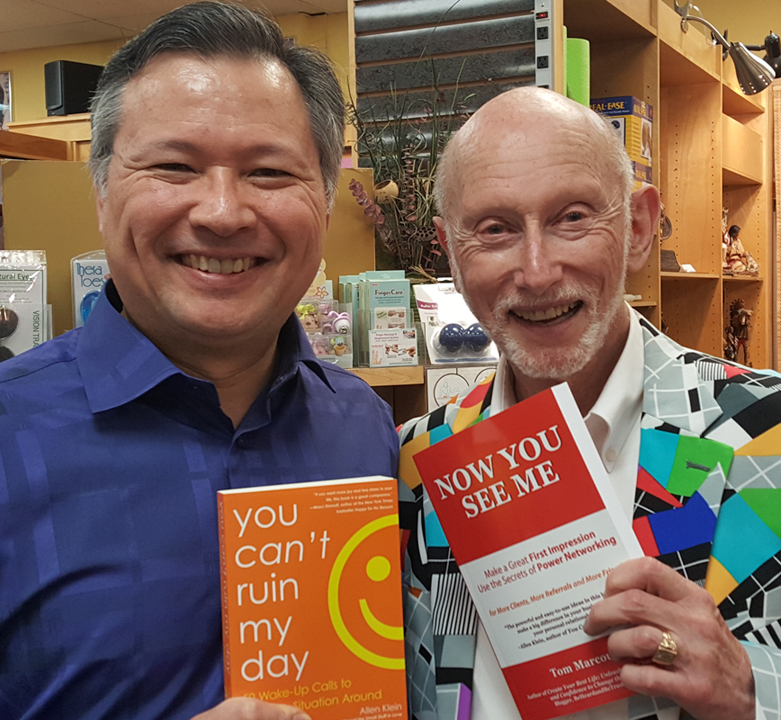
Tom holds Allen Klein’s book “You Can’t Ruin My Day” and Allen holds Tom’s Book “Now You See Me.”
Tonight, I learned from author Allen Klein as he gave a speech on his book You Can’t Ruin My Day.
Allen opened with a story of how he was driving in San Francisco through a tunnel that begins with a speed limit of 35 miles an hour, but ends with a limit of 25 miles an hour. He missed seeing the sign signaling the change. Soon a police officer gave him a ticket. (Some gift!)
At the gym, he was still able to apply himself to his exercises cheerfully. Others were surprised. And he noted that he wasn’t going to let the speeding ticket ruin his day. And such was the inspiration of his new book You Can’t Ruin My Day (look inside his book when you CLICK HERE).
From Allen’s speech, I will always remember his emphasis of this quote (which is on page 132 of his book):
In the scheme of things, what you do and whether you are angry or not will have the impact of another glass of water being thrown over Niagara Falls. Whether you choose laughter or anger will not matter much – except that the former will fill your present moments with happiness, and the later will waste them in misery.” – Wayne Dyer
Allen went on to tell the value of “stop struggling.” He tried for months to find a new publisher to re-release seven of his books. Then within two months of Allen’s posting “The Perfect Publisher Finds Me” as a note on his computer monitor, he sat in an audience. Two people nearby had a discussion about a publisher opening a new division that would be ideal for his books. It turned out that the publisher’s office was merely five blocks from Allen’s home. The next day he delivered his books, and the publisher immediately published one of his books! Allen’s affirmation is: “The world treats me as royalty everywhere I go.”
In his book, he notes how another author asked, “Why can’t someone ruin your day?” Upon reflection, Allen realized what his real answer is: “Because I won’t let them.” Allen’s book provides 52 Wake-Up Calls to Turn Any Situation Around. I’m so glad that I have a copy of Allen’s book. I love learning from a great teacher — the world’s only Mr. Jollytologist.
* * *
I truly agree with Allen’s approach. Every night, I write in my Daily Journal of Victories and Blessings. Sometimes, I write “Good day. Some bumpy moments.” That’s how I process the idea that I had many enjoyable moments and just a few moments were troublesome. A couple of moments do NOT a whole day make.
I invite you to practice shifting your thoughts. One thing does Not need to ruin your day. You can find it inside yourself to call the situation “bumpy moments.”
And then you have taken back your power.
You have chosen to apply a positive meaning to your day.
Warmly,
Tom
Tom Marcoux,
CEO
author of 27 books (with free chapters on Amazon.com )
Executive Coach
Spoken Word Strategist
Author of Love Yourself to Financial Abundance and Spiritual Joy: How You Can Remove Blocks to Your Prosperity, Happiness and Inner Peace (Free Chapter when you CLICK HERE )
Save money and time when you communicate powerfully.
Have you heard that a lot of stress is avoidable? How? Communicate with precision. We’ll use the W.O.W. process:
W – write notes
O – offer to repeat their words
W – work out a form
1. Write notes
Taking notes during interactions has literally saved me thousands of dollars. I note the time, date, and person I’m talking with. I send a follow-up email with my notes included. I know of a person who gained $100,000 when he said to someone on the other side of the table: “Okay. Let’s look at my notes and your notes.” The other side failed to have thorough notes.
Taking notes and writing them into a follow-up email message creates a “paper trail.” Assumptions lead to slipped deadlines and big misunderstandings that suck up time like the undertow at the beach. Protect yourself: take excellent notes and file them.
2. Offer to repeat their words
How do you know that you’ve truly understood someone’s intent? Repeat much of their words back to them. It can sound like: “So I heard you to say Part One of Project 1-2-3 is most important. Do I have that about right?”
At that point, the other person will add to or correct your interpretation. (For more about communicating powerfully, see a free chapter of my book Be Heard and Be Trusted when you CLICK HERE)
3. Work out a form
At one point, I heard someone talk about how her client returned with anger about expectations that were not met.
In response to her question, I suggested: “How about having a form to fill out at the beginning of a project?”
Here’s an example of a few questions that one writer can use as a survey form before adapting a book into a screenplay for a new client:
a) What’s the main theme of your book?
b) What is a scene that must be in the screenplay?
c) Summarize the point or theme of your book in one sentence:
(example from the film Tootsie: “A man becomes a better man by portraying a woman.”
* * *
As you can see from the above questions, using a form can help both client and contractor identify vital elements of a project.
Using the W.O.W. process saves you time and money.
Avoid needless frustration.
Then you have more energy and less stress.
You’ll be more able to apply yourself to productive and profitable pursuits.
Warmly,
Tom
Tom Marcoux,
CEO
author of 27 books (with free chapters on Amazon.com )
Executive Coach
Spoken Word Strategist
Author of Love Yourself to Financial Abundance and Spiritual Joy: How You Can Remove Blocks to Your Prosperity, Happiness and Inner Peace (Free Chapter when you CLICK HERE )








 Grab FREE ebook: “Develop Your Extreme Confidence and Seize Advantages in Business and Life”


 Book: "What the Rich Don't Say About Getting Rich: Work Smarter, Live Better"
 YourBodySoulandProsperity.com