Author Tom Marcoux went to Mayan ruins to see what his characters would see in his novel.
Standing at Mayan ruins with a video camera on me, I realized I was stuck. I had no words. I had no title for the book that I was supposed to describe at this extraordinary location.
With little time to get this video recorded, I felt baffled and even embarrassed. I paused for a moment and took in several deep breaths. This helped me connect and become flexible. I then realized that I could just refer to “the book.” Later, after more reflection and testing, I could come up with the name of the book. At that point, I’d have the title of the book superimposed on the video image.
Learn to Release Yourself from Limited Thinking and a “Fixed Identity”
When I searched for a solution while on camera at the Mayan ruins, I needed to have real flexibility. I’ve learned that getting stuck and having a focus on looking good or hanging onto an old, fixed identity can stand in the way. You can put up a barrier to your new chapter of life. You may hold yourself back from unprecedented success.
Additionally, when we release ourselves from limiting beliefs, we can radiate enthusiasm that makes us attractive to people and opportunities.
With clients, I use the word “FUN” as part of bringing these ideas to their attention.
F — Free yourself from a fixed identity U — Uncover “Creative Energy” N — Name 3 Focal Points
1. Free yourself from a fixed identity
Have you noticed that life is a series of chapters? Some of us get to the end of a chapter, and we experience a bad surprise. For example, when my father stopped running marathons, he lost a huge part of his identity. From that moment forward, he became truly bitter. He was lost without his identity as a marathon runner.
I’ve been fortunate to have a series of experiences like having different lifetimes. I’ve been a feature film director, lead singer of a band, song composer, educator, professional speaker from New York to New Zealand (including Thailand, Silicon Valley, Calif. and more).
It helped when I let go of a fixed idea that I was only a feature film director. I realized that I’m a communicator in various media. I learned to step forward with courage — into the unknown.
What opportunities are in front of you that are new and different? Do you need to step forward with a bit of courage?
2. Uncover “Creative Energy”
One of my mentors said that people get caught up with “who they are” and become overly protective of that “who.”
Carol Dweck talks about having the fixed mindset and how young people who are told that they are talented start to limit their actions. These fearful young people want to avoid proving themselves “untalented” in some area. So, they avoid taking appropriate risks.
On the other hand, if you think of yourself as “Creative Energy,” then you have no particular fixed identity to protect. You can try something creative like songwriting and think of it as an experiment. Perhaps, you can go from songwriting to screenwriting. Maybe, you’ll find that you’re more adept at screenwriting than you were at songwriting. But you develop your creative skills all along the way. You free yourself of holding onto a fixed idea like “songwriter.” You just look on yourself as Creative Energy.
What possible creative things can you experiment with now?
3. Name 3 Focal Points
Have you been surprised by how much people who have no experience with something still push their opinions on others? These people make pronouncements of what a person should not do.
Some people proclaim: “You should specialize in only one thing.”
Instead, if you only focus on one thing, you might become too afraid to take appropriate risks with that one thing. I’ve learned about the Power of Identifying 3 Focal Points.
When you identify 3 Focal Points, you have more freedom. This goes hand-in-hand with having flexibility and letting go of a fixed identity.
Additionally, having 3 Focal Points helps you avoid being scattered. Still, you’ll have more opportunities. Sometimes, the 3 Focal Points will combine in ways you had no idea might happen.
What 3 Focal Points seem to be attractive to you at this moment and at this chapter in your life?
In summary, you’ll find more freedom when you take action related to this F.U.N. process. You may have more fun, which will make you more attractive. Why? Because people like to be around others who are full of enthusiasm and creativity. They want you to succeed, and they offer you opportunities.
Many great moments to you.
Call to Action
To connect with your creativity and build for the future … Go deeper and take my online courses:
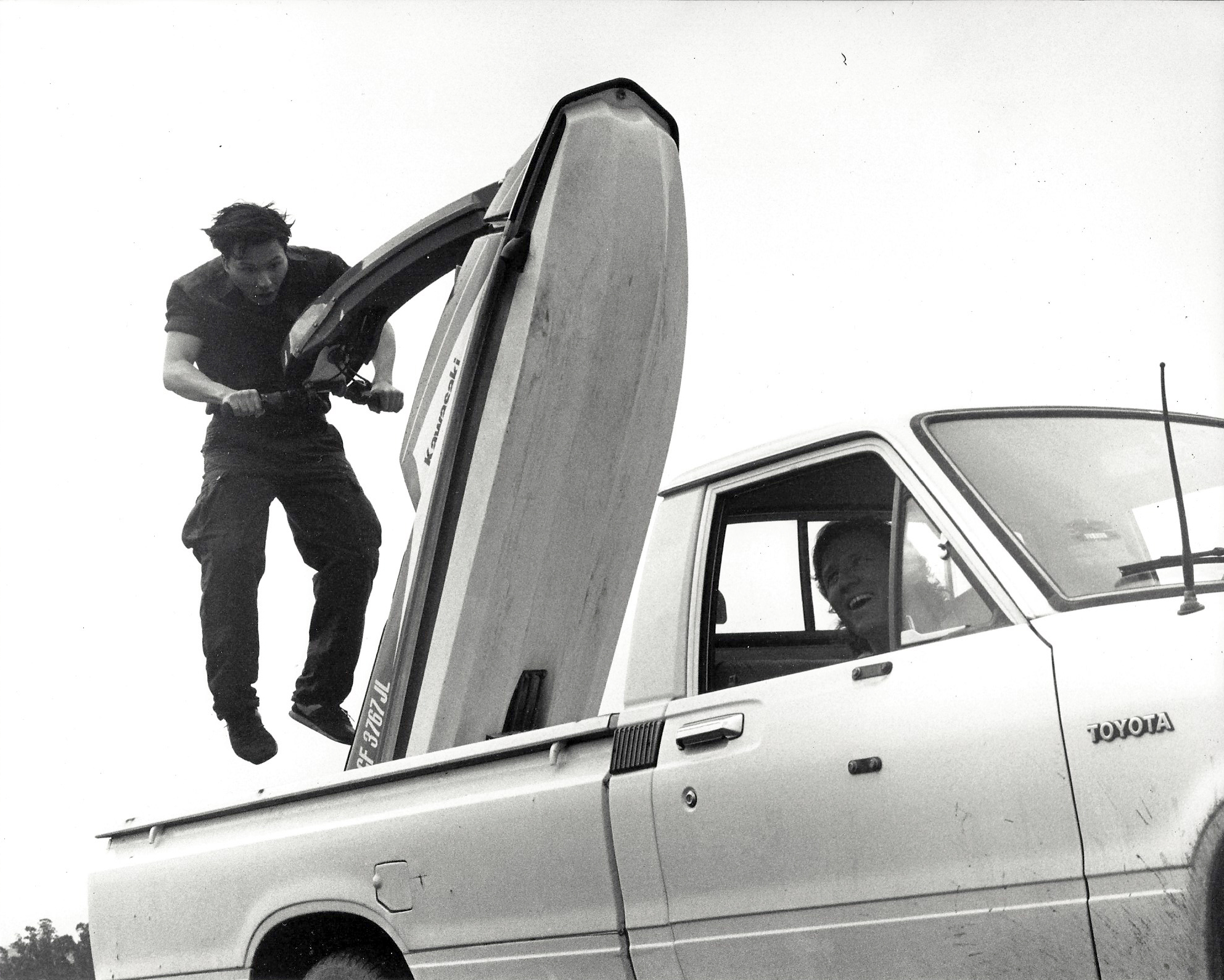
Tom Marcoux lands a jet ski in a truck’s flatbed for a feature film that Tom directed.
The stuntman on the jet ski attempted the “submarine trick” for a scene of a feature film I was directing. He wiped out amid a huge splash. He was unable to dive the jet ski underwater and then pop up like a dolphin.
We were running out of time to film the scene because we were “burning daylight.” That means the daylight was waning.
I had a choice: Send him back out to re-attempt the stunt or use an “editing trick.”
Using my mind’s eye, I edited the scene in my imagination. I had my answer. I said, “Go out there and make a huge splash like you’re recovering from the submarine stunt.” He did the motion.
In the final cut of the movie, the first shot is the stuntman causes his jet ski to dive underwater, and the second shot is a closeup of the lead actor emerging from the waves. The sequence ends with the big splash that simulates that the character successfully completed the submarine trick.
When the stuntman failed to complete the submarine trick, it felt like a disaster.
Fortunately, using my intuition and imagination, I solved the problem.
My point is: It may look like a disaster, but with imagination you can find your solution.
Here’s an example. Some time ago, I hired someone to edit a writing project for me. When I saw the mistakes left in the project, I was shocked. When you create a written work, the whole point is to serve the reader. This so-called editor did not watch my back.
I needed to find someone I could trust to help me.
Looking for a solution, I next talked with Daniel, a friend, who complained, “I don’t get relevant feedback from my writing group.”
I paused and let my imagination flow toward originating a new solution.
I innovated something I call “5 for 5.”
Later, I described “5 for 5” in this post I placed on Facebook:
#LeverageTip: Here’s a way to share kindness. I call it “5 for 5.” You read something you’re working on — for 5 minutes, and your friend gives helpful comments. Then, your friend reads something of their own for 5 minutes, and you provide supportive comments. (I just went through 800 pages with 15 friends in this manner … in 54 days). I helped people with LinkedIn profiles, sales emails, web pages, first novels and more. This deepens friendships and creates empowering energy, momentum and progress. many blessings
What difficulty are you facing?
Can you do something like “5 for 5,” in which you offer support and receive support, too?
Recently, I watched the series Into the Unknown: Making of Frozen 2. I noted that even on the highest levels of film production, team members face huge unknowns and problems. The solution requires caring people teaming up and supporting each other as they stretch and innovate solutions.
Now you have another tool you can use: “5 for 5.”
May your projects go well.
Call to Action
To connect with your creativity and build for the future … Go deeper and take my online courses:
Discover Your Strength in a Crisis (Succeed Even If – Ep 65) Tom Marcoux, Johanna E http://GetTheBigYES.com Book mentioned: “Soar! Nothing Can Stop You This Year: How to Unleash Your Hidden Power to Persuade Well, Get More Done, Gain Sudden Profits, Command Intuition and Feel Great” – Look inside at https://amzn.to/2XO9SC3
I didn’t know that the key to a better life was in the 39-year-old book in my hand. I had not seen this book in two decades. I only found it because during the coronavirus crisis, I was dealing with some materials in storage.
Opening the book at random, I discovered an idea that has stayed with me. The book is Isaac Asimov on Science Fiction. I wondered what I might learn from viewing this author’s words. I found his story about a woman named Peg, who was the wife of the famed science fiction editor John W. Campbell, Jr.
John Campbell and Isaac Asimov fell into a big argument. Their dispute escalated and became worse. They even wrote letters that hammered at each other.
Peg read the letters from both men and told them, “Any more and the friendship will be destroyed, and this argument is not worth a friendship.” John Campbell and Isaac Asimov dropped their argument and talked about other things. The friendship was saved.
Years later, John Campbell died. Asimov ended his chapter of the book with: “Then [Peg] died, too, in 1979. But I remember her.”
“But I remember her.”
For weeks, this phrase resonated in my mind like the chorus of a song.
Why did Asimov remember Peg? She was the peacemaker who saved his friendship with her husband, John.
My question for you is: How will you be remembered? As a friend? As a peacemaker — as someone who did the most important things? Or someone who got caught up in small things in anger and in arguments?
Recently, a friend on Facebook invited people todescribe themselves in Three Words.
This brings us back to Peg and “But I remember her.”
I think of Peg as peacemaker, friend, memorable.
What is most important to you?
Have you noticed that our energy is being drained by the coronavirus crisis and upheaval throughout the world?
To stay strong, do something each day that nurtures your spirit and your well-being. Then, you’ll have the energy to have a positive impact on people and the world around you.
Strength rises in focus.
How would you describe yourself in three words?
… and how would people, who are important to you, describe you in three words?
Call to Action
To connect with your creativity and build for the future … Go deeper and take my online courses:
Find Your Inner Strength and Peace in This Time of Crisis and Fear (Succeed Even If – Ep 64) Tom Marcoux, Johanna E. http://GetTheBigYES.com Book mentioned: “Discover Your Enchanted Prosperity: How You Can Increase Your Financial Abundance, Success and Happiness — and Enjoy Your Spiritual Journey” – Look inside at https://amzn.to/2zOSzqS
Succeed Even If You Need True Security When Pressed by Fear – Ep 62 – Tom Marcoux, Johanna E. http://GetTheBigYES.com Book mentioned: “Power Time Management: More Time, Less Stress, and Zero Procrastination” – Look inside at https://amzn.to/2VwDdQA
Who do you trust? Who trusts you? The answers to these questions relate to how trust will make you strong during the coronavirus crisis.
Just today, I remembered my father, who destroyed a sacred religious object that my mother owned. I saw this as a kid. I didn’t trust my father then. His grabbing me by the hair and tossing me into walls also left scars. Decades later, I still do not trust this man.
He’s remained self-righteous about why he acted as he did.
These experiences cut deep. I rebelled against my father’s ways. I’ve lived my life to be trustworthy.
Trust means a lot now.
Every day, bad news bleeds on news broadcasts and social media about the tragedies related to the coronavirus crisis.
Why is trust relevant during the coronavirus crisis? Because many people are devoting so much time sheltering in place with family members and partners. The New York Times reported that “A New Covid-19 Crisis: Domestic Abuse Rises Worldwide. Movement restrictions aimed to stop the spread of the coronavirus may be making violence in homes more frequent, more severe and more dangerous.”
Can we trust each other to act in calm and appropriate ways? Can you trust yourself to avoid overreacting and lashing out?
What can you trust?
I’ve learned that one thing we need is a Personal Energy Buffer— that’s extra energy.
Trouble shows up, and you need extra energy to think clearly and often to restrain yourself from a rash emotional reaction. (My father did not care to stop his rash emotional reactions.)
In movies, heroes take action. In real life, real heroes often stop themselves from lashing out emotionally.
How can you trust yourself? You need to strengthen yourself with your daily actions.
Look at your daily actions and people in your life.
Check in with yourself and ask, “Does this strengthen me?”
We need a Personal Energy Buffer. We need extra energy to think clearly and restrain ourselves from overreacting.
Here is a step in the right direction. Make sure to schedule some time to focus on three areas: Creativity, Connection and Compassion.
Creativity
To keep up your morale, every day find a way to create something. Find a way to take some steps forward. Build something for the future. This is something that will help you feel better. It can positively affect your health. Being creative will help you maintain healthy levels of hope and vision.
Connection
Every day find a way to connect with someone you care about. Especially focus on connecting with Uplifting People. An Uplifting person is someone who can lift your spirits even in in a 9-minute phone call. Listening to a friend can improve your energy. Just yesterday, I listened as a friend read to me his first draft of a dialogue scene. I felt great by providing support. It’s valuable to combine creativity and connection. Find ways to do something fun with your partner or family members. These moments of connection warm up your relationships. For example, one family has a specific, tiny teddy bear for games of “find the teddy bear.”
Compassion
Compassion for yourself can empower you to have more patience. Additionally, compassion for others is a great foundation for creating good relationships. Researchers demonstrate that good relationships improve the health and well-being of people. Good relationships help you feel more capable and strong. When you demonstrate compassion toward yourself, you make sure to do things that nurture your well-being. David, a friend of mine, found himself getting irritable with family members. So, one night, while his family members were asleep, he watched the feature film written and directed by Richard Curtis, About Time. He laughed, and he cried. He later told me it was a “good cry.” He released some emotions and felt better. His next day with family went well. Perhaps, you’ll take a break by watching a film that makes you laugh or even makes you cry. Safely releasing emotions helps you stay calm.
How can people find you to be trustworthy? It’s when you take good care of yourself so you can trust yourself to stay calm and present in the moment.
Make sure to have moments of your day devoted to a routine that includes Creativity, Connection and Compassion. Build up your Personal Energy Buffer. This is how you’ll be able totrust yourselfto stay calm and avoid overreacting. When you do that, you’ll feel stronger. As people trust you — the good relationships will empower you, too.
May we all stay safe and well during this time of crisis.
Call to Action
To connect with your creativity and build for the future … Go deeper and take my online courses:
After a significant amount of undersea swimming, Tom Marcoux endured cramps in both legs.
What’s worse, when swimming in the ocean, than a cramp in your left leg? I found out. A cramp in both legs! How am I still alive? My sweetheart pulled me into shore. I helped by swimming with my arms — so she wasn’t alone in saving my life. Still, my legs were no help.
Many of us approach the need to give the best speech or sales presentation in our lives like we have cramps in both legs. I’m using cramps as a metaphor for what shuts you down. The “cramps” include the obstacles: Fear, procrastination, and the perception of rehearsal as a bad chore.
Additionally, this relates to the 3 Deadly Mistakes centered on No Time, No Rehearsal, No Pretesting.
What does this boil down to? — No coaching.
The good news is: I can serve as your coach here.
Here are the 3 Deadly Mistakes:
1) No Time (Mistake: I’ll just procrastinate and do something at the last minute.)
2) No Rehearsal (Mistake: I’ll just have a few notes and talk off the cuff.)
3) No Pretesting (Mistake: I’ll just wing it. I know what I’m talking about.)
When I was in the ocean, the cramps made my legs nonfunctional. The 3 Deadly Mistakes cramp your ability to do what’s necessary to speak powerfully and inspire people to say Yes to you.
Here are 3 Methods so You Can Rapidly Improve and Make Your Breakthrough Speech or Presentation:
1.Use a Streamlined Process for Rapid Improvement (Solution to “No Time”)
I advise my clients to rehearse for 9 minutes-a-day over several days. This yields better results than cramming all the rehearsal into one night-before, 3-hour session. Why? Because the multiple sessions engage your subconscious mind. Have the 9-minute session early so your subconscious mind works on the material all day long. Additionally, have brief phone calls with friends and say, “Can I practice the opening one minute of my speech with you?”
In my work as the Spoken Word Strategist, my focus is on a Streamlined Process. With a coach like me, you have someone who can ask the right questions that help you find your best material faster.
2.Use “Directed Rehearsal” (Solution to “No Rehearsal”)
Many of us fall into a “default” of rerunning a bad memory in our thoughts. If you were embarrassed when speaking in a high school class, it’s easy for your brain to rerun that failure. I call this bad pattern Default Rehearsal. The brain falls into the default pattern.
Instead, I introduce my clients to Directed Rehearsal. I guide my clients in the process of putting in New Conditioned Responses. These New Conditioned Responses overwrite the default patterns. Research shows that, under stress, people fall back into the default settings. However, when you have New Conditioned Responses, you are freed of the old, painful default settings.
One method (among many) is to preplan two answers for each “worst question” you might get. I guide my clients to have two answers for the 10 Worst Questions. My clients rehearse their answers in response to my questions. They develop an inner-knowing that they are well-prepared.
I look on this preparation for the 10 Worst Questions as a way to avoid the “cramp” that can torpedo a great presentation.
One reason people fail to rehearse effectively is that fear arises when rehearsing. Such fear often leads to procrastination. Why? Because even thinking about the speech can lead to pain and more fear. Instead, as a client works with me, we are able to move forward fast. I’m there so the client feels real support.
3.Use a “Discovery-Rehearsal Process” (Solution to “No Pretesting”)
How do you know if your material is going to sound natural? The solution is to speak your words aloud to someone you select carefully. A coach can be helpful because the coach only has your success as his or her agenda. Friends and family members can have their own agendas.
Pretesting is crucial. We pretest how your material comes across to a test audience. Additionally, we pretest what language you express feels authentic inside you.
I guide my clients through a Discovery-Rehearsal Process. By rehearsing parts of your speech or presentation, you uncover the language that is most compelling and that feels most natural coming from you.
What can put a “cramp” into your speech? Certain family members or friends will not have the capability to support you. I have a particular family member who has no capability to be supportive. Years ago, I realized that talking to this person was the place where good ideas go to die.
Instead, I developed a circle of people for helpful guidance. For one particular pitch, I rehearsed with 12 different individuals in separate phone conversations. I devoted a total of 25 rehearsals. I realize that many people will not go to that level of preparation. That’s why having a coach can save you so much time. My background as a feature film director has given me experience to draw out a great presentation from my client.
In summary, we talked about three major mistakes that center on No Time, No Rehearsal and No Pretesting.
We covered these Solutions:
1. Use a Streamlined Process for Rapid Improvement 2. Use “Directed Rehearsal” 3. Use a Discovery-Rehearsal Process
You’ll discover how you’re able to get more done in less time. You’ll have ways to make breakthroughs in your communication and your work life.





 Grab FREE ebook: “Develop Your Extreme Confidence and Seize Advantages in Business and Life”


 Book: "What the Rich Don't Say About Getting Rich: Work Smarter, Live Better"
 YourBodySoulandProsperity.com